
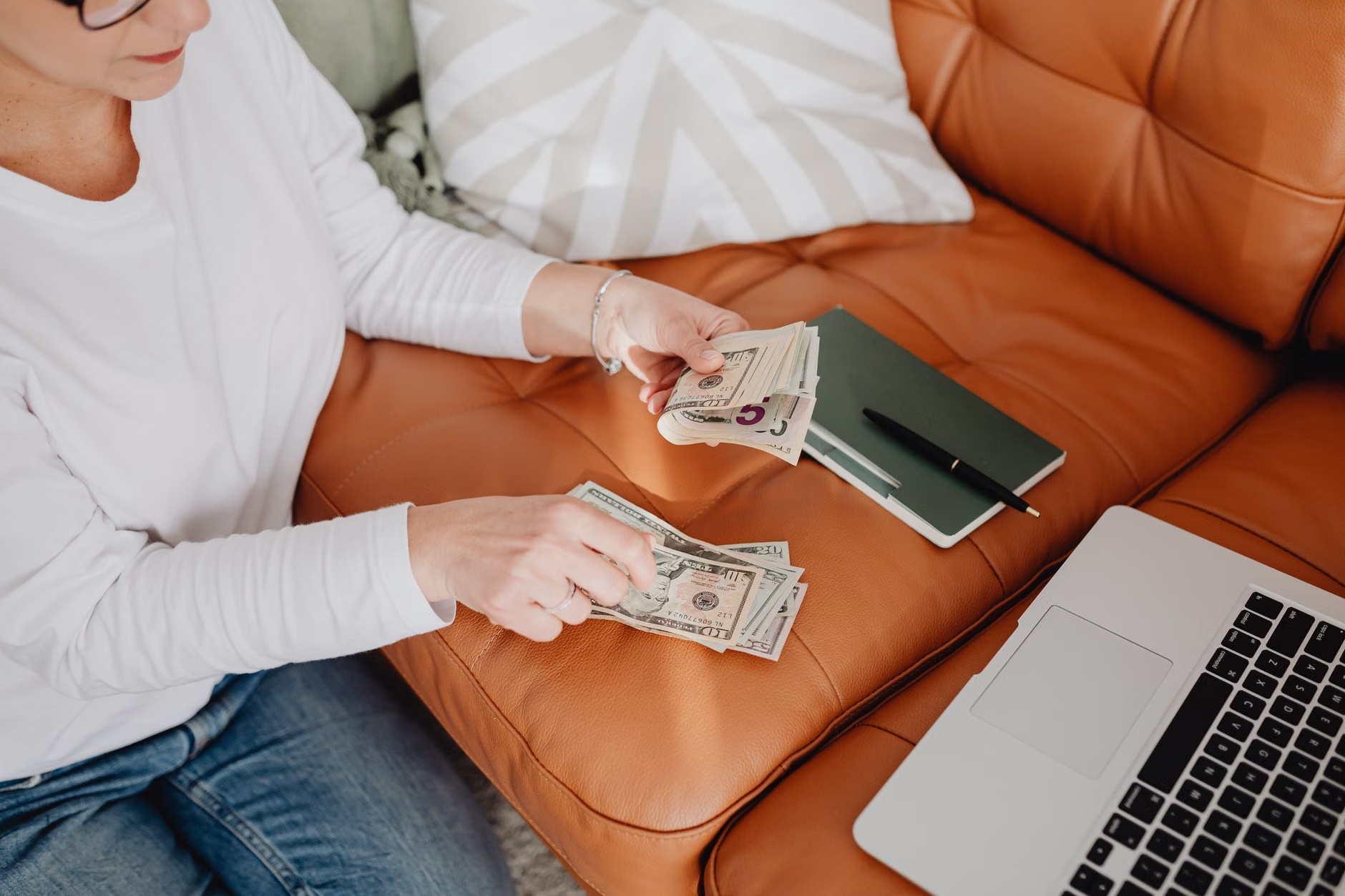
Starting with $100 is less of a disadvantage than a constraint that can encourage good habits. In many cases, it is enough to open an investment account, use fractional shares, and buy a first fund position. What matters more is turning that first deposit into a repeatable investing habit instead of trying to find a miracle stock. (investor.gov)
First decide whether this $100 belongs in the market at all
Before buying anything, decide whether this money should be invested or kept safe. Investor.gov says savings accounts are a better fit for short-term goals and emergency cash, while investing is better suited to long-term goals that can stay invested through market swings. If this $100 may be needed for rent, a car repair, or a move in the next few years, keeping it in cash is usually the smarter first step. (investor.gov)
- Need the money within the next few years? Keep it in savings, not stocks. (investor.gov)
- No emergency cushion yet? Building even a small cash buffer can come before investing.
- Carrying high-interest credit card debt? Paying that down may be a better first use of a small amount of money.
A common beginner mistake is treating a small amount like entertainment money. That often leads to a volatile single stock, a trendy theme fund, or whatever is popular this week. A starter investment should teach process: choose an account, buy something understandable, and leave it alone long enough for the habit to form.
Choose the account before you choose the investment
Different account types exist because goals, services, fees, and tax treatment can differ. For a $100 start, the practical choice is usually between a regular brokerage account for flexibility and a tax-advantaged retirement account, such as an IRA, if the money is truly meant for long-term retirement use. (investor.gov)
- Use a regular brokerage account if flexibility matters and there is a real chance you may want access to the money before retirement.
- Consider an IRA if this money is clearly for retirement and you are willing to check the account rules before funding it.
If $100 will not buy a full share of the investment you want, fractional shares can solve the problem. The catch is that brokerage firms do not all handle them the same way. The SEC says availability, eligible securities, order types, fees, liquidity, and transferability can vary by firm, so it is worth reading the account details before you tap Buy. (investor.gov)
For most beginners, one broad fund is a better first buy than several tiny bets
With only $100, spreading money across several random ideas usually creates clutter, not diversification. Investor.gov explains that index funds track a market index, and mutual funds or ETFs can make diversification easier by pooling many holdings in one investment. A broad U.S. stock index fund, broad-market ETF, or an age-appropriate target-date fund is often a cleaner starting point than an individual stock. (investor.gov)
There is one important nuance: not every fund is actually broad. Investor.gov specifically warns that a mutual fund or ETF can still be narrowly focused, such as on one industry sector. That means a trendy AI, cannabis, battery, or single-country fund may hold many securities and still behave like a concentrated bet. If the goal is learning to invest with minimal drama, broad beats clever. (investor.gov)
Make the first $100 useful by turning it into a system
- Open the simplest account that matches the goal.
- Buy one broad investment you can explain in one sentence.
- Set up automatic contributions, even if it is only $10 or $25 at a time. Investor.gov describes regular investing as consistently putting set dollar amounts into your accounts. (investor.gov)
- Check the fund name before buying so you know whether it is broad-market or narrowly themed. (investor.gov)
- Review the account a few times a year, not a few times a day.
A simple hypothetical example looks like this: someone with $100, no immediate cash need, and a long retirement horizon opens a basic account, buys $100 of a broad index ETF or target-date fund, and then adds $25 a month. The first purchase is small, but the system matters. It reduces the temptation to wait for a “better time” and turns investing into something routine instead of dramatic. (investor.gov)

$100 will not build wealth overnight, and it is not enough to hide sloppy decisions behind. That is exactly why it can be a good starting amount. If the money is truly for the long term, use it to open the right account, buy one broad investment, and automate the next contribution. A small first move, done well, is often more valuable than a bigger amount left on the sidelines.
References
- U.S. Securities and Exchange Commission, Investor.gov: Introduction to Investing – https://www.investor.gov/introduction-investing
- U.S. Securities and Exchange Commission, Investor.gov: Investment Accounts – https://www.investor.gov/introduction-investing/investing-basics/investment-accounts
- U.S. Securities and Exchange Commission, Investor.gov: Asset Allocation and Diversification – https://www.investor.gov/introduction-investing/getting-started/asset-allocation
- U.S. Securities and Exchange Commission, Investor.gov: Fractional Share Investing – Buying a Slice Instead of the Whole – https://www.investor.gov/introduction-investing/general-resources/news-alerts/alerts-bulletins/investor-bulletins/fractional-share-investing-buying-slice-instead-whole-share?chain_id=Name1K9-3FXPhg.1ksoo00&global_content=%7B%22promote_id%22%3A14079%2C%22sub_promote_id%22%3A30%2C%22f%22%3A%22www.moomoo.com%2Fmy%2Flearn%2Fdetail-how-to-trade-us-fractional-shares-117043-240565002%22%7D