

Set money aside for food, medication, and transportation to work until your next reliable paycheck. After that, set money aside to avoid the most serious and immediate consequences (such as eviction, losing essential services, losing insurance, etc.) you depend on to work and earn an income. The person calling the most or the person with the largest balance does not always deserve the first payment.[1]
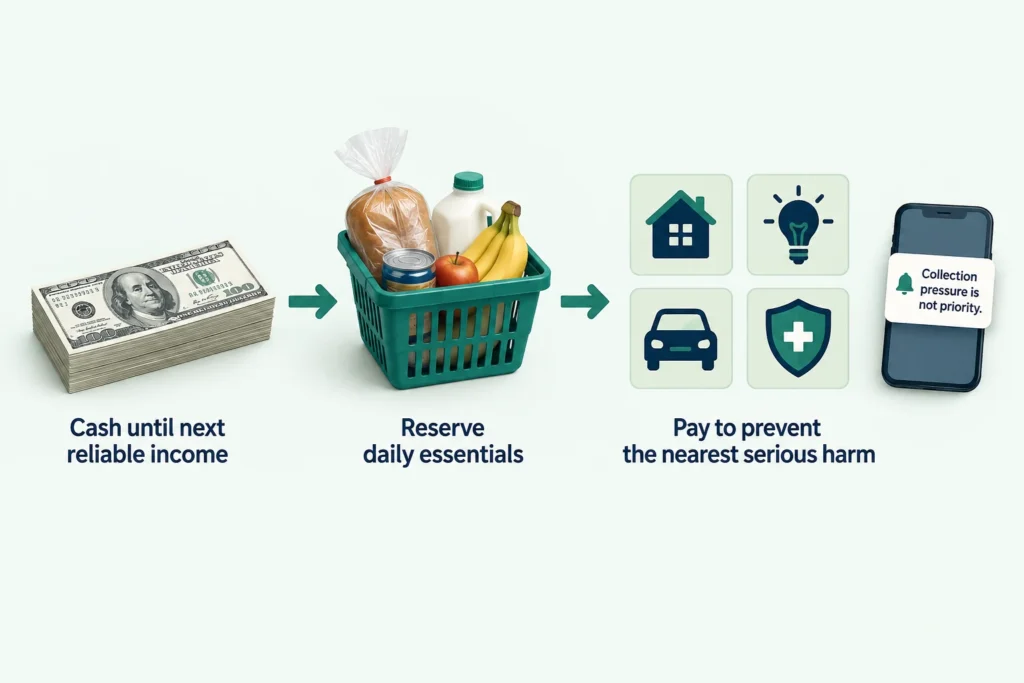
I would rather see you protect the three essential obligations with confirmed arrangements (eviction, utility shut-off, or insurance lapse) than send a small payment to each and face a shut off. This means looking beyond the normal due dates to the amount and due date that actually cause the greatest harm. This is not a case of a bad attitude or 'tough love.'
Start with money you can actually use
Consider your cleared cash and the date your next reliable income arrives. The account balance can be misleading because a debit or a withdrawal could be scheduled in the future to take that money. You have to subtract the payment to cover the debt or withdrawal before you can allocate money for anything else. An assistance application does not mean cash is available to you.
Set aside money for food and transportation to work and for medication until your next reliable paycheck arrives. Keeping money for these things means you are able to work and earn an income and provides the means to take care of any obligations you have for the bills you have already incurred. Now you can think about cutting spending for the future.[1]
Look for the next consequence, not just the due date
For each bill, mention the following: the next likely consequence, deadline, and the amount/arrangement that would eliminate the bill. This information is more useful than simply organizing bills by due date. For example, an electricity bill that is about to be cut off, and a credit card payment that is due the next day, are prioritized differently, even if the credit card bill was due several months earlier. Late fees, notices of cancellation, deadlines, and default on a contract are not the same.[1][2][4]
I typically prioritize the protection of housing and essential services first, but I cannot do that here with your bills alone. A financed and already-defaulted car may be the only way you can get to work. Child care and a working phone may also serve the same purpose. Court-ordered obligations and other unsecured debts are prioritized differently.[1][2]
- Rent: The three-day pay-rent-or-quit notice in California (that excludes Saturdays, Sundays and court holidays) is not a notice to vacate. Local court orders may provide extension and other protective orders. Don’t assume transfer these rules to other states.
- Car Loan: According to the FTC, some states allow contracts to provide that, after the default, the lender may take possession of the collateral without notice, and may sell it to the best advantage, subject to the right to redeem. Texas Legal Aid states that a lender may also provide insurance, and loss of that insurance may also lead to default and possible repossession. A lender’s late fee may not protect you from repossession.
- Insurance: California states that a residential insurance policy may not be cancelled without at least ten days’ notice. This is not a nationwide or general rule for insurance policies. Confirm your cancellation date and time, payment deadline, and the consequences for the policy.
For utilities, call the provider to find out the exact date of disconnection, and ask about what protections are available due to weather, medical needs, or assistance programs. Be sure to ask about required documents. Don’t assume a pending application will stop a shutoff. Get a clear response about your account.[4]
Ask for relief that changes what happens next
When you call the highest-risk payee, be prepared with the bill, any notice you received, and the amount you can actually afford. Tell the payee what you can afford, and ask for options to change the next step in the collection process. The CFPB suggests payment plans, date changes, and forbearance for auto loans. For credit cards, the forbearance request and hardship letter should be expedited, and approval is not guaranteed.[2][8]
A reduced payment is only useful if the rest of the agreement fits too. Ask about the next installment, fees, interest, and credit reporting. Keep the representative’s name, contact date, confirmation number, payment method, and receipt deadline with the written terms and your receipt. Then check that any promised hold on enforcement appears on the account. I’d want that confirmation, not just a pleasant call.[2][7][8]
Sending something can feel better than sending nothing, but it may leave the danger unchanged. A mortgage servicer, for example, may hold a partial payment in a separate account until enough accumulates for a full periodic payment. Ask how your money will be applied and what remains overdue; the transfer alone doesn’t prove you’ve cured the delinquency.[9]
What a $635 shortfall could look like
Imagine I’m sorting these fictional bills on October 3, with a collector calling while I search for an electricity notice buried in my email. I feel pulled toward paying the caller just to get some quiet. Then I find the disconnection date. I put the phone down and call the utility first: silence won’t help if the lights go out.
Let’s say I have cleared cash of $1,200, and there are no pending debits. I also have my paycheck on October 16. Setting aside $200 for food, medication, and work access leaves $1,000 to pay the $1,635 in bills. This means there is a shortfall of $635. Setting aside the notice, dates, and arrangements, these are created for the purposes of this example. These are not legal grace periods.
| Obligation | Amount requested | Timing and consequence | Payment or next action |
|---|---|---|---|
| Rent | $900 | Due October 1; unpaid housing obligation | Landlord agrees in writing to $500 October 3 and $400 October 16, with no nonpayment action if both arrive as agreed. |
| Electricity | $240 | Notice lists October 7 disconnection | Utility confirms $80 received by October 6 stops disconnection; remaining $160 due October 23. |
| Needed insurance | $120 | Notice lists October 8 cancellation | Insurer confirms full $120 received by October 6 maintains continuous coverage. |
| Credit-card minimum | $75 | Due October 5; possible fees and account consequences | Request hardship relief; no payment allocated in this plan. |
| Ordinary unsecured collection demand | $300 | Collector requests payment October 4; no court papers or judgment in this example | Verify the debt and discuss an affordable later arrangement; no payment allocated now. |
The immediate allocation is $500 + $80 + $120 = $700, leaving $300 earmarked toward the $400 rent installment on October 16. The paycheck must provide the other $100 to fulfill the rent payment obligation. Setting aside the $1,635 requested, $935 is still past due: $400 rent, $160 electricity, $75 credit card, and a $300 collection demand. These are the remaining payment demands and obligations, not necessarily the full obligations. Nothing is settled, the agreements just bought more time.
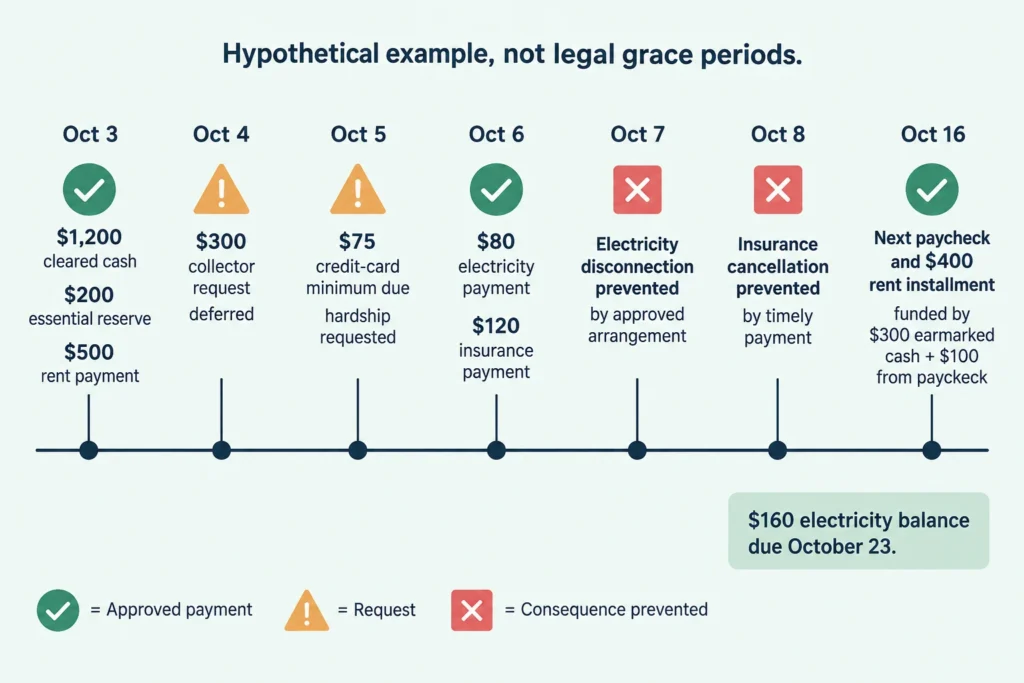
If landlord doesn't work with us, that’s $900 rent, $80 for electricity, and $120 insurance = $1,100 against $1,000 available. Still $100 short. Paying the collector $300 would leave $700 and increase uncovered amount to $400. That’s why I care more about the consequence than the pressure.
When the proposed plan still doesn’t fit
Persistence of a collector doesn’t make a normal unsecured debt more pressing than keeping essential services. Get signed information about the debt and the collector to verify before making any payment. Court papers are different; respond to the Court and get legal-aid assistance as quickly as you can. Restricting calls may buy you some time, but it doesn't stop legal collection actions.[7]
If the shutoff is scheduled, ask for an urgent review from the hardship team, and contact the utilities Regulator. California’s CPUC has various payment plans for its jurisdiction of privately owned utilities. Ask about emergency assistance, but don't remove the shutoff hold until you get a confirmed hold. A pending request is still a pending request.[4]
Upon receiving an eviction notice, the first call should be to legal aid to review the papers and see if they can intervene. The bills alone don’t typically validate the notices or set the deadlines. If your car has already been repossessed, the lender may have the paperwork, so it’s best to call to find out and see if there is a payment that can stop the repossession. Another notice may not be forthcoming.[2][3][5][6]
The next call should be regarding the unpaid bill with the most serious consequence. If you can’t afford to pay the essential bills each month, I wouldn’t ask you to track which bills you can pay and which you can’t, because that is no way to live. You may need additional income or assistance or a larger change in your fixed costs to be able to pay the bills that you are able to afford to pay.
Sources and references
- Consumer Financial Protection Bureau: Prioritizing bills
- Consumer Financial Protection Bureau: What should I do if I can't make my car payments? (2023-09-12)
- Federal Trade Commission: Vehicle Repossession (2023-09)
- California Public Utilities Commission: Make a Payment Plan
- California Courts: Types of eviction notices tenants
- Texas RioGrande Legal Aid / TexasLawHelp: Repossession, Vehicle or Property (2023-01-02)
- Consumer Financial Protection Bureau: Know your rights when a debt collector calls
- Consumer Financial Protection Bureau: What should I do if I can't pay my credit card bills?
- Consumer Financial Protection Bureau: Your mortgage servicer must comply with federal rules
- California Department of Insurance: Residential Insurance: Homeowners and Renters