

Usually, yes. For cash that needs to stay safe and reasonably accessible – such as an emergency fund, a home-repair reserve, or money for a planned purchase in the next year or two – a high-yield savings account is often worth opening. The appeal is straightforward. Under federal Truth in Savings rules, banks must disclose APY, interest-rate terms, minimum-balance requirements, and fees, which makes deposit accounts easier to compare. And if the account is at an FDIC-insured bank, deposits are generally protected up to $250,000 per depositor, per ownership category, per bank. (consumerfinance.gov)
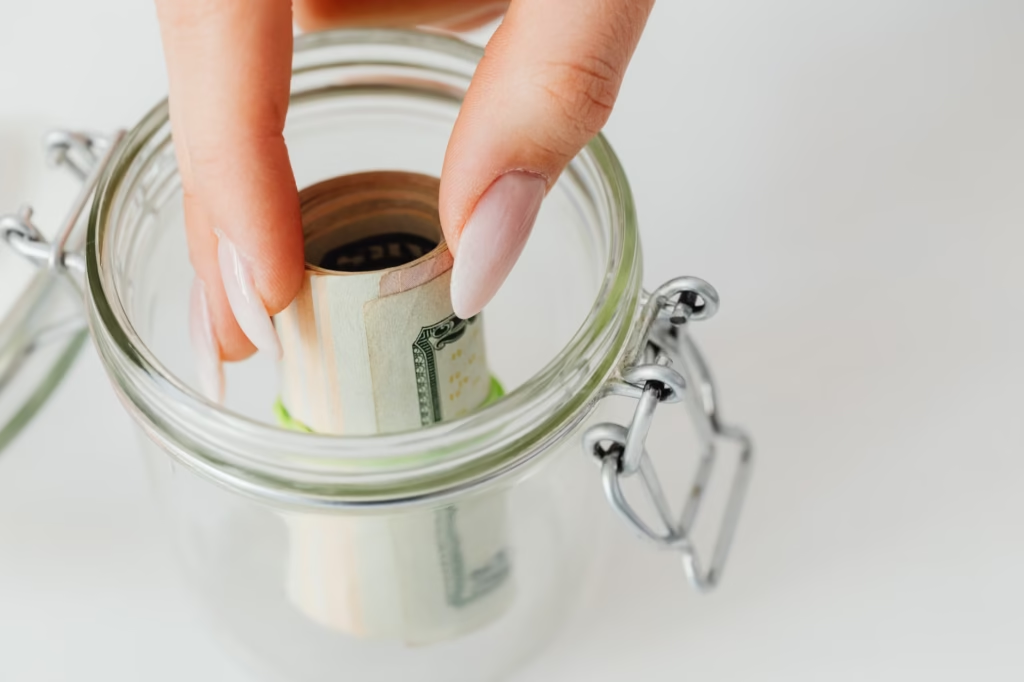
They are best for cash you may need soon
What makes these accounts worthwhile is the difference between earning something meaningful on cash and earning almost nothing on money that was going to sit in savings anyway. A high APY will not turn a savings balance into a long-term growth plan, but it can make idle cash less wasteful. As a simple hypothetical, $10,000 earning 4.00% APY would generate about $400 over a year, while 0.40% would generate about $40, assuming the rate stayed the same and ignoring taxes. That is the right way to think about a HYSA: it is a cash-management tool. (consumerfinance.gov)
That also explains when a HYSA is not the point. If the money is needed for next week’s bills, a checking account may be more practical. If the goal is decades away, the bigger question is whether cash is the right vehicle at all. A HYSA earns its keep in the middle ground, where safety and access matter more than chasing maximum growth.
Use a short checklist before you move money
The harder question is not whether high-yield savings accounts are good in theory. It is whether a particular account is good enough to justify switching to. A five-point review usually answers that faster than a flashy advertised rate. (consumerfinance.gov)

- Start with APY, because that is the standardized figure banks disclose for deposit accounts and the cleanest apples-to-apples comparison point. (consumerfinance.gov)
- Check whether the rate is variable, how often it can change, and whether a minimum balance is required to open the account, avoid a fee, or earn the stated yield. (consumerfinance.gov)
- Read the fee disclosures carefully. A modest monthly maintenance fee can erase much of the extra interest on a smaller balance. (consumerfinance.gov)
- Confirm the bank is FDIC-insured and understand the coverage limit: $250,000 per depositor, per ownership category, per bank. (fdic.gov)
- Review access rules before opening. The old federal six-per-month transfer limit was removed from Regulation D in 2020, but a bank may still keep its own withdrawal or transfer policies and must disclose transaction limitations. (federalreserve.gov)
That checklist helps prevent the most common mistake: chasing a headline rate without checking the terms. Some accounts only become attractive above certain balances. Others may technically pay well but create enough friction that they are annoying to use. In practice, the best account is usually the one that combines a competitive APY with low fees, clear rules, and easy transfers to and from your main checking account. (consumerfinance.gov)
The real tradeoffs are rates, access, and taxes
The main tradeoff is that a HYSA pays for liquidity, not certainty. Unlike a CD, the rate on a savings account can move. CFPB disclosure rules require banks to tell customers if the rate is variable, how it is determined, and how often it may change. That means a strong APY today can look ordinary later. Another point many savers overlook is taxes: interest from a savings account is generally taxable in the year it is credited and available for withdrawal. So the number that matters is not just the posted APY, but the after-fee, after-tax value of keeping that money in cash. (consumerfinance.gov)
If you are keeping more than $250,000 in single-owner deposits at one bank, do not assume a second savings account at the same bank creates extra FDIC protection. Coverage is based on depositor, bank, and ownership category, not simply the number of accounts. (fdic.gov)
One more nuance matters in real life. The best HYSA for many households is not necessarily the one with the absolute highest advertised rate. A slightly lower APY can still be the better choice if the bank has no monthly fee, a straightforward transfer process, and terms that are easy to live with. The goal is to improve the return on safe cash without creating a new hassle every time money needs to move. (consumerfinance.gov)
Most are worth it, but only for the right job
For most people holding short-term or emergency cash, a high-yield savings account is worth it. It is a practical upgrade over leaving savings in a low-paying account, as long as the bank is insured, the fees are low or nonexistent, and the access rules fit what that money is supposed to do. Just do not treat a HYSA as the answer to every financial goal. It works best when the job is simple: keep cash safe, accessible, and earning a better return than an ordinary savings account. (fdic.gov)
References
- FDIC – Understanding Deposit Insurance – https://www.fdic.gov/resources/deposit-insurance/understanding-deposit-insurance
- CFPB – 12 CFR § 1030.4 Account disclosures – https://www.consumerfinance.gov/rules-policy/regulations/1030/4/
- Federal Reserve Board – Savings Deposits Frequently Asked Questions – https://www.federalreserve.gov/supervisionreg/savings-deposits-frequently-asked-questions.htm
- IRS – Topic no. 403, Interest received – https://www.irs.gov/taxtopics/tc403